
There’s almost always a noticeable cosmic event going on up in the night sky that’s worth seeing. This section of our website is your resource for DIY stargazing. Any time you want to know what’s happening up in the sky that’s worth seeing, check this page. We suggest that you download and print the current month Skymap to help you locate the featured cosmic objects. All objects can be seen by the naked eye on very clear nights, through a pair of binoculars, or a small, no less than a 3″ aperture, telescope.
OUR FEATURED ASTERISM
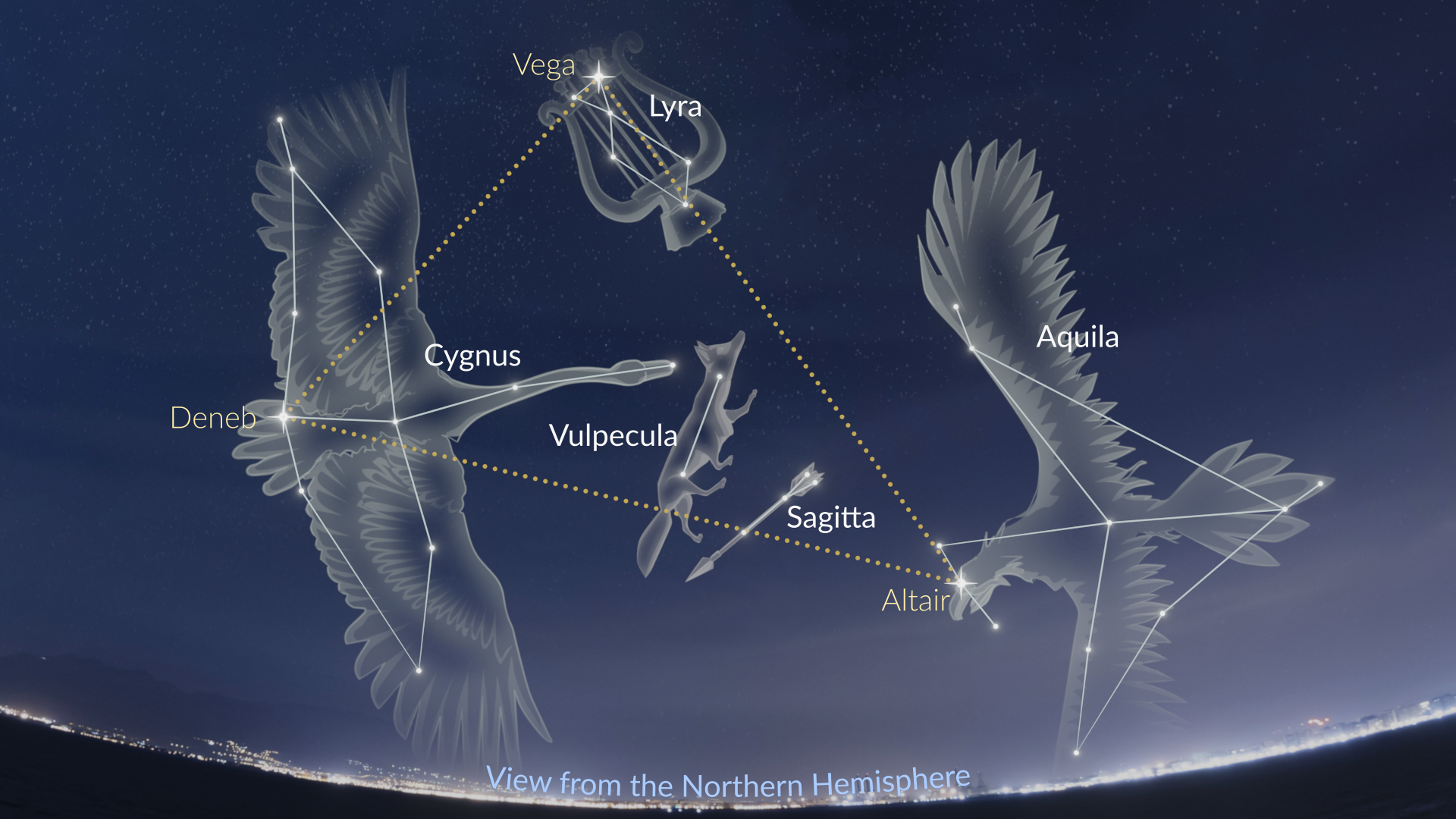
An asterism is a noticeable pattern of stars that is not a constellation. The Summer Triangle is a prominent asterism in the northern hemisphere and is formed by the three stars Altair, Deneb and Vega, each of which is the brightest star of its constellation. Look East or Southeast after dark to see the blue-white star Vega. Vega is the brightest star in the constellation Lyra (the Lyre) and is the third brightest star in the Northern Hemisphere, after Sirius and Arcturus. Vega is so bright that it can be seen from light polluted areas and after sunset would be the first star to appear in the sky. From Vega, look down to the left – 24 degrees away is the star Deneb in the constellation Cygnus (the Swan). To measure degrees without special tools, stretch out your arm and make a fist. A clinched fist measures about 10 degrees. To the lower right of Vega is the star Altair, the brightest star in the constellation Aquila (the Eagle). The distance between them is 34 degrees, about one fist more than from Vega to Deneb. That’s it! Connect these three stars and you’ll get the Summer Triangle. Before GPS and other navigational devices, military navigators called this asterism the Navigator’s Triangle as it was commonly used to get orientation on the seas. The Summer Triangle is not just a pattern of three bright stars – it is also a great starting point for exploring the Milky Way. With the naked eye, look for Vega, Deneb and Altair first. Under a dark sky, you may be also notice a pale band of the Milky Way running through Cygnus, near Deneb. With a good pair of binoculars, sweep the area between Vega and Altair to find rich star fields and the Coathanger, one of the easiest binocular targets inside the triangle. With a small telescope try finding Alberio, the colorful double star in the constellation Cygnus. Printing out a star map will help you locate and identify these stars and constellations. Use the Skymaps.com link on our Home Page to print this month’s sky chart. We suggest that you order a planisphere to help find your way through the night sky.
OUR FEATURED CONSTELLATION
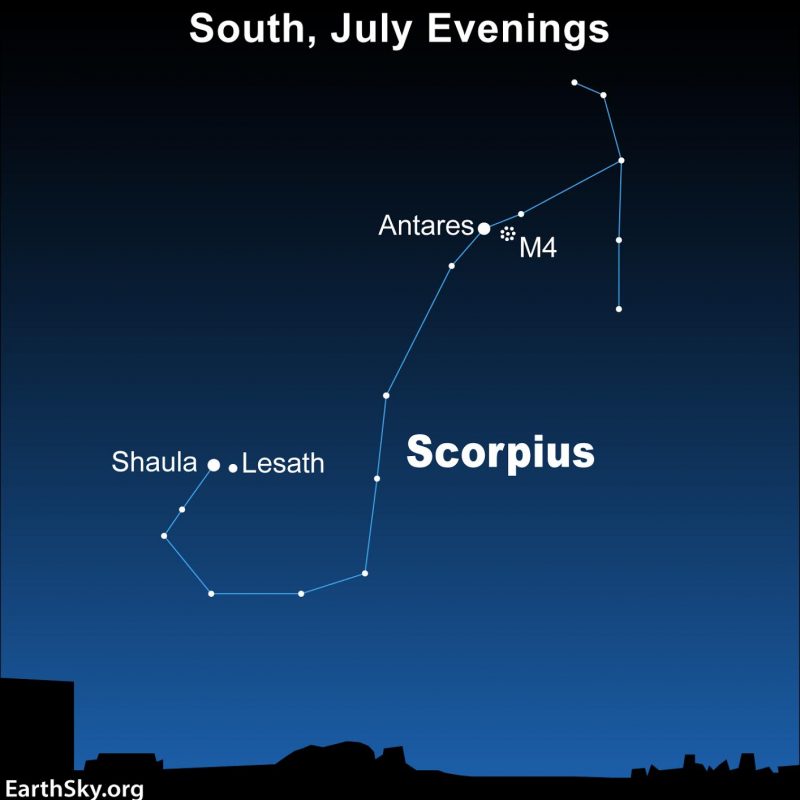
Scorpius (the Scorpion) is the eighth and most southerly constellation of the zodiac. Scorpius is arguably the only constellation immediately recognizable as the creature it is intended to represent. If the constellation’s curved tail with it’s stinger does not capture one’s attention, then its redish-orange beacon the star Antares will. Antares is also called the “star of the Northern Summer”. Scorpius is best viewed when highest in the sky shortly after sunset. In Greek lore, Scorpius represents the Scorpion “of very great size” that was sent forth to defeat Orion. The result of the battle has different endings. In one version, the scorpion stings Orion in the heel, and he succumbs to the venom. In another version, Orion defeats the scorpion in a mighty battle. Regardless of the outcome, Zeus admired the courage of both and placed them in the sky as a lesson to all to not be too self-confident. If you watch these two constellations year round you will notice that Scorpius is still chasing after Orion. When Scorpius rises, Orion sets, and visa versa. We think the battle is still raging and there has yet to be a victor.
OUR FEATURED STAR
Antares is the brightest object in the constellation Scorpius. From the Greek ant-Ares, meaning “the rival of Mars”, Antares is the Scorpion’s Alpha star (Alpha Scorpii) and the 15th brightest in the sky and is 550 light years from our solar system. It marks the position of Scorpius’ pulsing heart. A red supergiant star, it’s diameter is 887 times that of our Sun,15 times more massive and 10,000 times more luminous. If Antares were our Sun, it’s body would stretch nearly to the orbit of Jupiter. Antares is actually a binary star system consisting of Antares and Antares B. The star does pulsate slightly over the course of years, signally that the star is nearing the end of its life, which will end as a supernova explosion in the next million years or so.
OUR FEATURED STAR CLUSTER
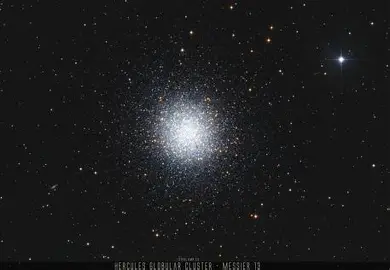
Messier 4 or M4 (also known as the Spider Globular Cluster) perhaps the closest globular cluster to our Sun, looks like a phantom orb even through binoculars under a dark sky. Observers with keen eyesight have spied this glow even without optical aid. A gravitationally bound collection of several tens of thousands of stars, this 13-billion-year-old senior citizen of our Galactic halo is a must see through any telescope. At low power, the stars of M4 start to be resolved. No other globular cluster in the night sky resolves so well. It is one of the easiest globular clusters to find, being located a little over 1 degree west of the bright star Antares in the constellation Scorpius. Back to using our hands to measure distance in the night sky like we did with our featured asterism, hold your hand straight out and hold up only your pinky finger. The width of your pinky finger is approximately 1 degree. M4 is approximately 6,000 light years away making it the closest globular cluster to the Solar System and is estimated to be over 12 billion years old. Although it may appear about the same size as the Moon in the sky, it is actually about 70 light years in diameter. Let’s look at the numbers maybe we can relate to. Maybe? The Moon’s diameter is 2,160 miles. The diameter of Antares is …. ready for this? 411,600,000,000,000 miles.
If you’re interested in joining other stargazing enthusiasts and educators for public stargazing events, check out our section on Public Stargazing Events. You’ll get to observe celestial events through telescopes and other stargazing gear provided by Event Horizon and it’s members in attendance, which makes for a more vivid and memorable stargazing experience.
Artemis Mission Update

Building on the success of the Artemis II mission which completed a 10-day crewed mission around the Moon in April, NASA is finalizing preparations for Artemis III, the first crewed mission designed to land astronauts on the Moon’s South Pole. The mission is currently focused on Earth orbit docking tests with commercial lunar landers from SpaceX and Blue Origin, ensuring the Orion spacecraft and human landing systems are fully operational for lunar descent in 2028. The crew for the Artemis III mission will be officially announced on June 9, 2026. Did you know that in Greek mythology Artemis was the twin sister of Apollo?